最近の論文発表 Recent publication
2026年発表論文 Published in 2026
A. Kobayashi, S. Odagiri
Artif. Photosynthesis 2026, in press.
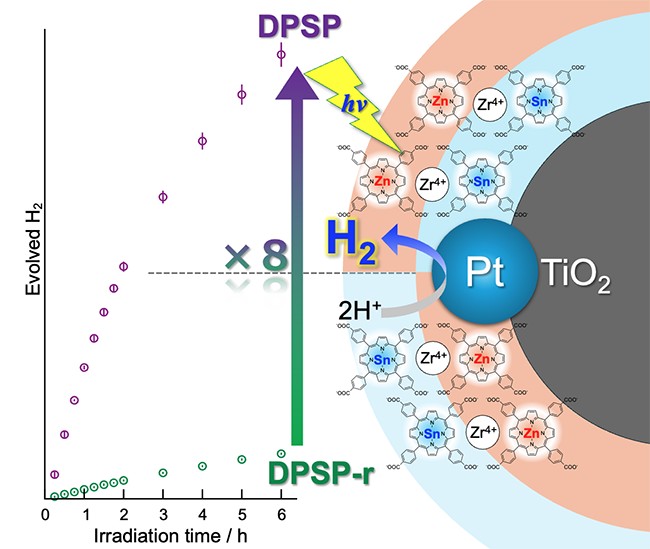
クリーンエネルギー源となる水素を生成する色素増感光触媒の実用化に向けて、高価な貴金属から安価かつ持続利用可能な材料へ代替することは非常に重要です。本研究では、従来の光レドックスカスケード触媒の色素として使われていたルテニウム貴金属錯体を安価かつ豊富に存在する亜鉛およびスズポルフィリン色素に置換した光触媒を新たに合成し、その光触媒活性を評価しました。ポルフィリン色素を用いた本系においても、スズポルフィリンを第1層に、亜鉛ポルフィリンを第2層に固定化した光触媒(DPSP)はその逆順で固定化したもの(DPSP-r)に比べて、見かけの量子収率が8倍以上も高いことがわかり、色素の担持する順番が活性に対して大きな影響を及ぼすことが明らかとなりました。ポルフィリン色素は中心金属によって特性を容易に制御できることから、さらなる色素多層化に基づく高活性化が可能と期待され、今後の発展が期待されます。
Toward the practical application of dye-sensitized photocatalysts for producing hydrogen as a clean energy source, it is crucial to replace expensive noble metals with inexpensive and sustainable materials. In this study, we synthesized a new photocatalyst in which ruthenium noble metal complexes—traditionally used as dyes in photoredox cascade catalysts—were replaced with inexpensive and abundant zinc and tin porphyrin dyes. We found that the photocatalyst (DPSP) in which tin porphyrin was immobilized in the first layer and zinc porphyrin in the second layer exhibited an apparent quantum yield 8 times higher than that of the photocatalyst (DPSP-r) immobilized in the reverse order, demonstrating that the order in which the dyes are supported has a significant impact on activity. Since the properties of porphyrin dyes can be easily controlled by the central metal, it is expected that higher activity can be achieved through further multilayer dye structures.
A. Kobayashi, Y. Huang, S. Noro
ChemSusChem 2026, 19, e202502241.
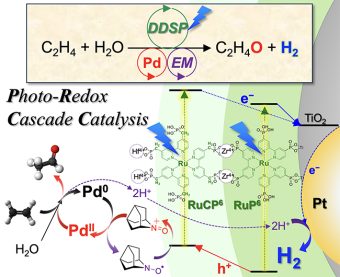
ワッカー酸化はエチレンやプロピレン等の末端オレフィン類を選択的にカルボニル化合物へ酸化変換する工業的に利用されている重要反応です。本研究では、ワッカー酸化に使われる酸化剤(空気中の酸素)をRu(II)色素二層化Pt触媒担持二酸化チタンナノ粒子光触媒の水素生成反応で生じる正孔に置き換えることで、ワッカー酸化と太陽光水素生成反応の同時駆動を目指しました。Pd触媒分子、有機ラジカルメディエーター共存下で青色光を照射すると、エチレンやプロピレン等のオレフィンガスを酸化しながら、水素を同時に生成できることを見出しました!現状ではPd触媒の耐久性に問題を抱えていますが、工業的かつ大規模に利用されているワッカー酸化からクリーンエネルギー源となる水素を大量生産できる可能性があり、今後のさらなる発展が期待されます。
The Wacker oxidation is an important industrially utilized reaction that selectively oxidizes terminal olefins, such as ethylene and propylene, into carbonyl compounds. In this study, we aimed to simultaneously drive the Wacker oxidation and solar hydrogen production reactions by replacing the oxidizing agent (oxygen in air) used in the Wacker oxidation with holes generated by the hydrogen production reaction of a dual Ru(II) dye-sensitized Pt-TiO2 nanoparticle photocatalyst. We discovered that when blue light is irradiated in the presence of a Pd catalyst and an organic radical mediator, hydrogen can be generated simultaneously while oxidizing olefin gases such as ethylene and propylene. Although there are currently issues with the durability of the Pd catalyst, this approach holds the potential to mass-produce hydrogen—a clean energy source—from the Wacker oxidation process, which is already used industrially, and further developments are anticipated.
2025年発表論文 Published in 2025
A. Kobayashi, A. Miura, K. Takahashi
RSC Sustainability 2025, 3, 4688-4702.
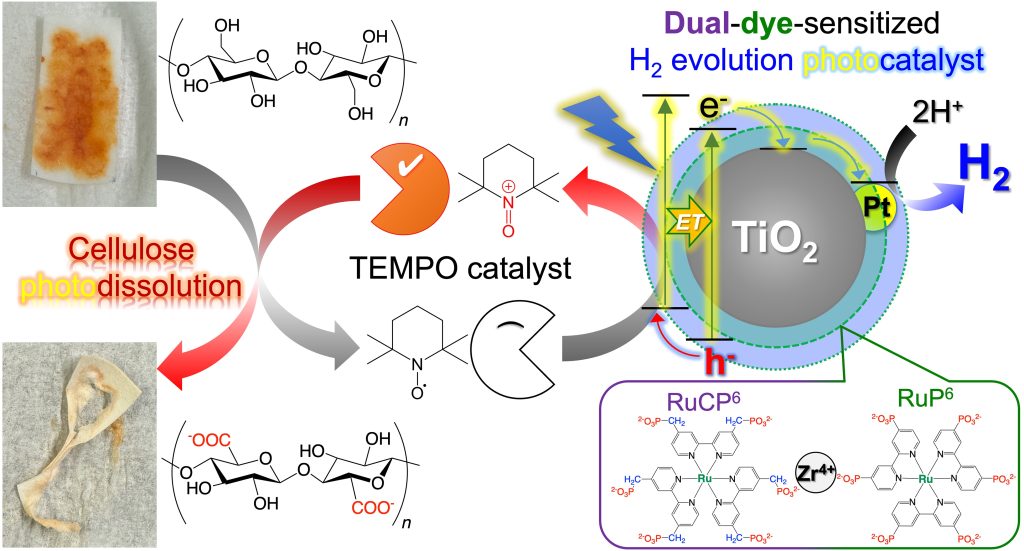
セルロースは地球上に最も豊富に存在する持続利用可能な炭素資源ですが、その資源化には非常に安定な構造を解きほぐすための膨大なコストが必要でした。本研究では環境に優しい光触媒反応によりセルロースを資源化するべく、Ru色素を二重化したPt-TiO2ナノ粒子光触媒の合成パラメータを機械学習を活用して最適化し、有機ラジカル触媒分子TEMPOを組み合わせた光レドックスカスケード触媒の活性向上を追求しました。その結果、DDSPをセルロース紙へ塗布することで、光触媒反応により水素ガスを生成しながらセルロースがナノファイバーへと徐々に溶出する特異な現象を見出しました。本成果はクリーンエネルギー源である水素と高機能材料として期待されるセルロースナノファイバーを同時に合成する効率的な手法として今後のさらなる発展が期待されます。
Cellulose is the most abundant sustainable carbon resource on Earth, but converting it into usable materials has traditionally required enormous costs to break down its highly stable structure. In this study, to convert cellulose via an environmentally friendly photocatalytic reaction, we optimized the synthesis parameters of Pt-TiO2 nanoparticle photocatalysts containing double-layered Ru dyes using machine learning, and sought to enhance the activity of a photoredox cascade catalyst combined with the organic radical catalyst TEMPO. As a result, we discovered a unique phenomenon in which, upon coating cellulose paper with DDSP, cellulose gradually dissolves into nanofibers while hydrogen gas is generated through the photocatalytic reaction. This achievement is expected to lead to further developments as an efficient method for simultaneously synthesizing hydrogen—a clean energy source—and cellulose nanofibers, which are anticipated to serve as high-performance materials.
A. Kobayashi
Coord. Chem. Res. 2025, 2, 100014
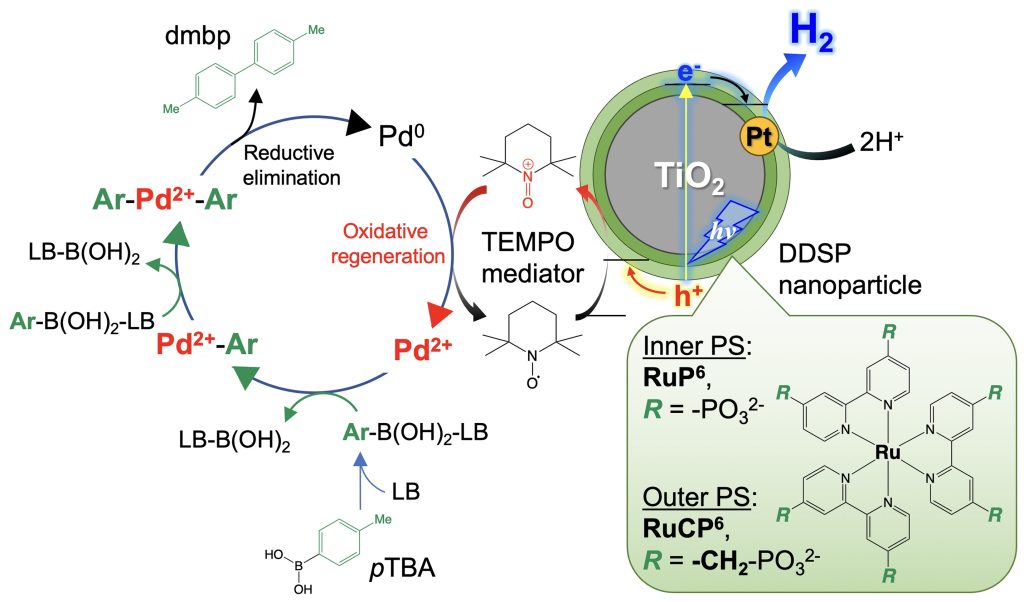
我々の生活を支える様々な有用有機化合物を生産するプロセスから太陽光エネルギーを利用して水素を得ることができれば、次世代水素社会を支える重要な水素供給源になると期待されます。そのような背景から本研究では、当研究室で開発してきたDDSPナノ粒子光触媒を様々な有機化合物変換反応に触媒活性を示すPd錯体触媒に連動させるべく、有機ラジカルTEMPOを介在させた新しい光レドックスカスケード触媒を構築しました。興味深いことに、本系ではアリールボロン酸からPd触媒によるホモカップリング反応を経てビアリールを合成するプロセスとDDSPが光触媒的に水素を生成するプロセスが、TEMPOメディエーターによって連動していることがわかりました。このような二重メディエーター系(Pd錯体触媒+TEMPO)を光触媒反応へ連動させた例は極めて少なく、さらなる発展が期待されます。
If we can utilize solar energy to produce hydrogen from the processes that generate the various useful organic compounds, this is expected to become a crucial hydrogen supply source for the next-generation hydrogen society. In this study, we constructed a new photoredox cascade catalyst involving the organic radical TEMPO to link the DDSP nanoparticle photocatalyst—developed in our laboratory—with Pd complex catalysts that exhibit catalytic activity in various organic compound conversion reactions. Interestingly, we found that in this system, the process of synthesizing biaryls via a Pd-catalyzed homocoupling reaction from arylboronic acids and the process of photocatalytic hydrogen generation by DDSP are linked by the TEMPO mediator. There are very few examples of such a dual-mediator system (Pd complex catalyst + TEMPO) being integrated into photocatalytic reactions. Further developments are anticipated.
A. Kobayashi
ChemSusChem 2025, 18, e202400688
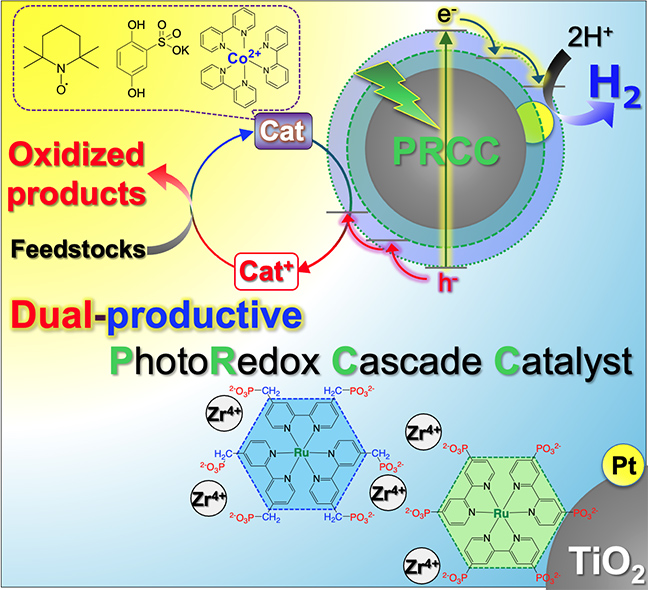
可視光駆動型水素生成光触媒反応は、クリーンで持続可能なエネルギー源に貢献すると期待され、精力的に研究されてきました。この光触媒活性を評価するために犠牲剤が一般的に使用されていますが、その不可逆的な分解は光電荷分離を強制し、光触媒が有する二重生産性(還元生成物と酸化生成物を同時に合成する能力)を損ねてしまいます。本コンセプト論文ではそのような背景を踏まえ、犠牲剤の不可逆的な分解に頼ることなく光電荷分離を誘起し、光触媒が有する二重生産性を担保できる光レドックスカスケード触媒(PRCC)の概要を紹介します。当研究室で開発してきたPRCCが、どのような経緯で発展してきたのか?ご興味ある方はぜひご一読ください。
Visible-light-driven photocatalytic hydrogen production is expected to contribute to clean and sustainable energy sources and has been the subject of intensive research. While sacrificial agents are commonly used to evaluate this photocatalytic activity, their irreversible decomposition forces photo-charge separation, thereby compromising the photocatalyst’s dual productivity—the ability to simultaneously synthesize reduction and oxidation products. This concept paper introduces Photo-Redox Cascade Catalysts (PRCCs), which induce photo-charge separation without relying on the irreversible decomposition of sacrificial agents, thereby preserving the dual productivity of photocatalysts.
2024年以前の論文発表はこちらをご覧ください。Click here to check our publication list before 2024.